
Criminal Court Cases in Chippewa County
Chippewa County criminal cases begin in the 91st District Court. That court hears misdemeanors, sets bond, and conducts the arraignment and preliminary work in felony matters. Its local explanation defines a misdemeanor as an offense punishable by as much as one year in the county jail, a fine of up to $1,000, or both. City, township, and state-law cases can appear on this docket. First- and second-offense operating-while-intoxicated cases are misdemeanors. A third offense is felony-level, yet it also starts in District Court.
The 50th Circuit Court receives a felony only after the District Court binds it over following a probable-cause finding or waiver. Circuit Court then holds the felony plea, trial, disposition, and sentence. It also hears appeals from District Court. That split matters because the District proceeding and Circuit proceeding have distinct case numbers and registers of actions. The clerk for each court keeps its own part of the public case file. Sault Ste. Marie has no separate municipal criminal court database.
The official 91st District Court page shows the local court hub and its docket resources.
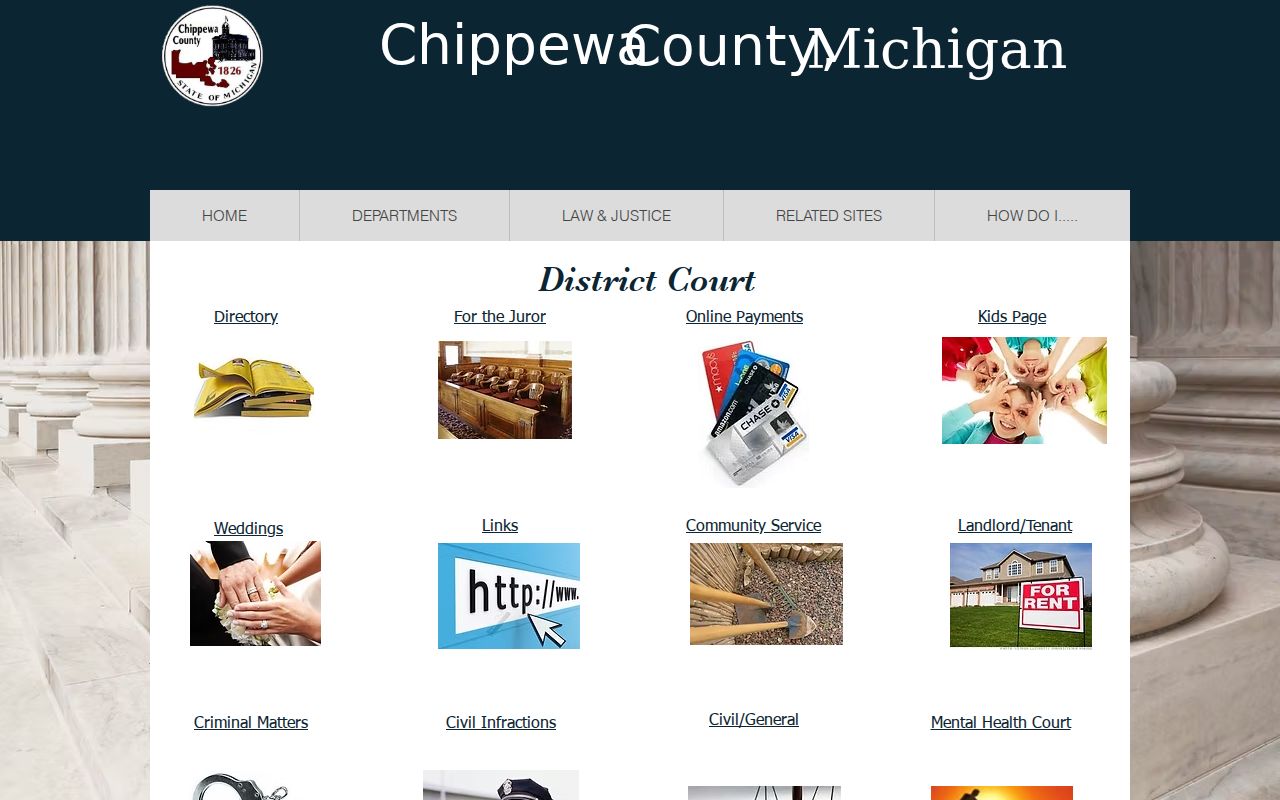
This local hub is the right starting point for a misdemeanor or the opening phase of a Chippewa County felony case.
Chippewa County Criminal Court Roles
The court name tells a searcher where the file should be. The offices sit close together in downtown Sault Ste. Marie, but they do not hold the same records. District Court is at 325 Court Street. Circuit Court is at 319 Court Street. Family and Juvenile Court occupies the courthouse Garden Level, though juvenile delinquency files are restricted and are not an ordinary public criminal-case search.
The Chippewa County District Court directory identifies the clerk, court staff, probation contacts, address, phone line, and public counter.
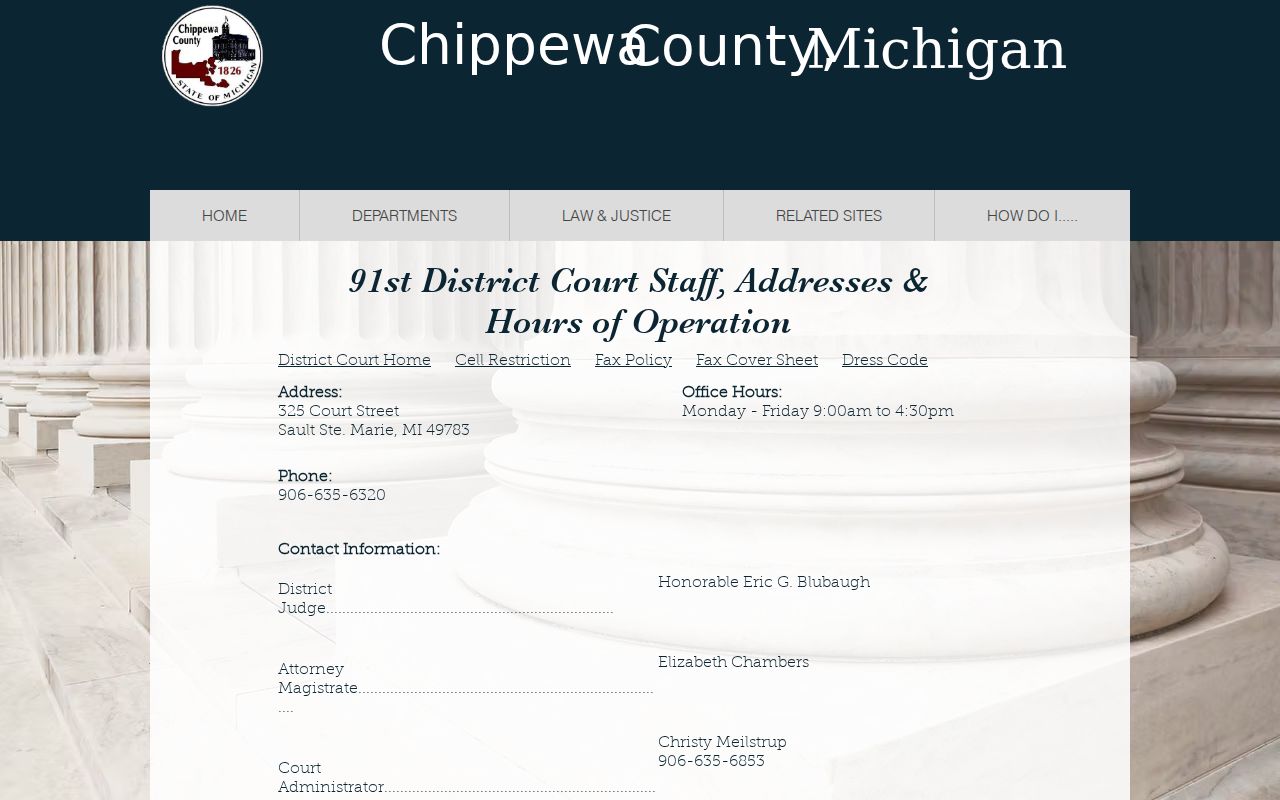
The directory helps a caller reach the proper court function instead of asking the Sheriff or Public Defender for a court-file copy.
91st District Court
325 Court Street
Sault Ste. Marie, MI 49783
906-635-6320
Monday through Friday, 9:00 a.m. to 4:30 p.m.
50th Circuit Court
319 Court Street
Sault Ste. Marie, MI 49783
906-635-6338
Monday through Friday, 8:00 a.m. to 4:30 p.m.
Chippewa County Case Record Searches
MiCOURT Case Search is the first remote channel for participating Michigan courts. Court selection comes before the party or case search. Search modes can vary by court, so use the full legal name and exact case number when available. A date of birth is useful when requesting a staff search, but the public screen may not expose that private identifier. The resulting register of actions is a dated list of events, not a full packet of downloadable pleadings.
- Open MiCOURT and choose the 91st District Court for a misdemeanor or the start of a felony.
- Enter the exact case number when known. Otherwise, search the full party name and narrow the time range.
- Record the case number, court, filing date, status, and charge or case-type code from the result.
- For a felony, repeat the search in the 50th Circuit Court and match the two proceedings by name, dates, and docket history.
- Read each register from oldest to newest, then request the judgment, sentence, dismissal, or other needed document from the clerk that holds it.
The available fields serve different purposes. A case number is the best key, while a name search may produce more than one person or matter.
| Field Label | Type | Required | Notes |
|---|---|---|---|
| Court | Selection | Yes | Choose District or Circuit for the stage sought |
| Party name | Text | Search option | Use the complete legal name |
| Case number | Text | Search option | Best exact key when known |
| Date range | Date | Varies | Narrows results and frames a clerk search |
| Date of birth | Date | For clerk search | Helps distinguish similar names |
Older Chippewa County Criminal Cases
A missing online result does not end the search. The District Court provides a free public-access computer during normal business hours. Staff can also search by name, preferably with a date of birth and a defined time period. The standard clerk search covers ten years. Files more than 25 years old need added time because those records are not fully computerized. The county describes the staff-search fee only as nominal, so the amount and any copy or certification charge should be confirmed with the clerk before ordering.
The local District Court record-search instructions explain the terminal, staff search, time-range requirement, and older-file delay.
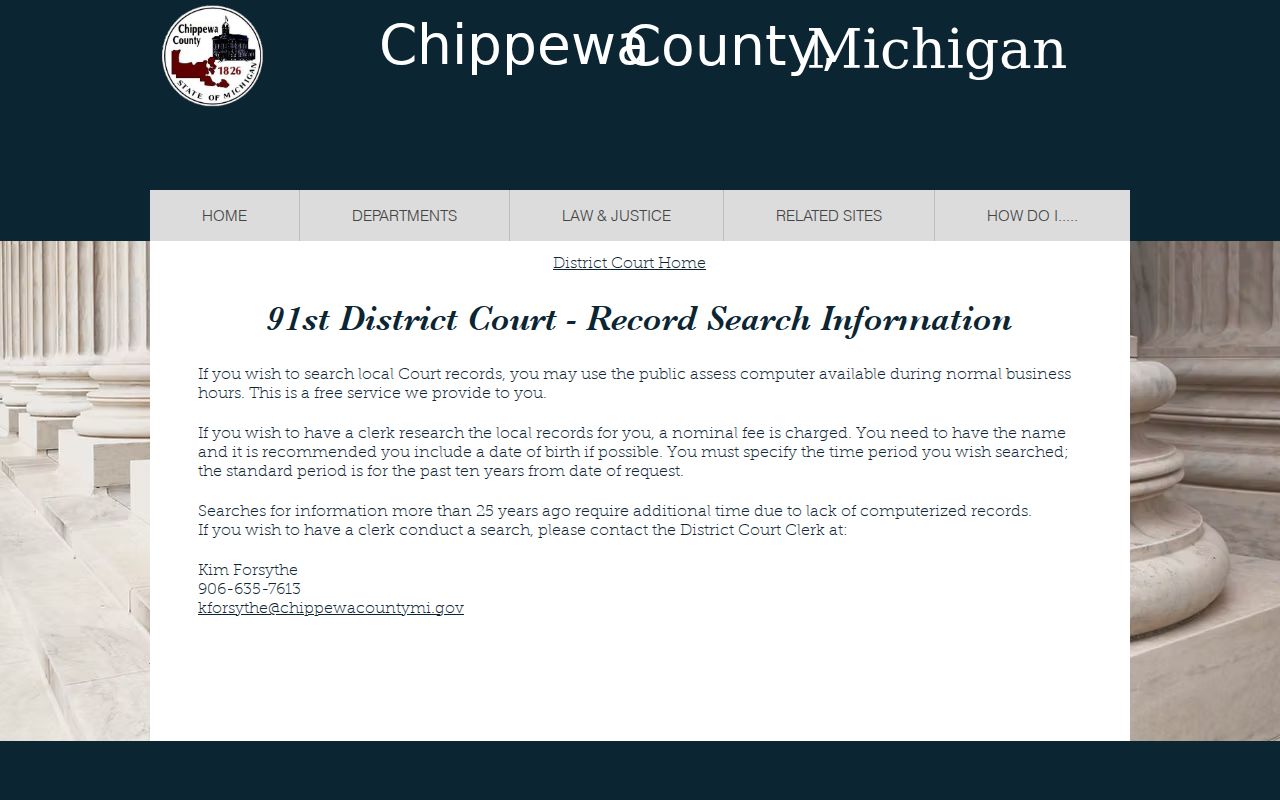
Those instructions provide the key fallback when MiCOURT does not return the expected Chippewa County criminal docket.
Call record-search clerk Kim Forsythe at 906-635-7613 or contact the court counter with a narrow request. Give the name, date of birth when legitimately known, and the period to search. If the matter was a felony, ask whether the District docket shows a bindover, then carry that detail to the Circuit clerk. Courthouse docket displays are also posted in the basement and on the second floor outside the courtroom.
What a Criminal Case File Contains
A public docket may show the court, case number, party display, case type, filing date, status, hearings, judge, counsel, event codes, and a short charge label. It may not provide the complaint, police report, victim details, date of birth, full sentence terms, or a downloadable judgment. The actual document matters when the short docket label leaves doubt. Ask for a plain copy for reading or a certified copy when an official seal and clerk certification are required.
| Case Number & Court | Identifies the specific proceeding, filing year, court, and case-type suffix. |
|---|---|
| Charging Document | The complaint starts the accusation; an information is the prosecutor’s felony charging document after bindover or waiver. |
| Docket Entries | A chronological register of filings, hearings, orders, pleas, and other court events. |
| Hearing Dates | Past or scheduled appearances, often with event type, time, judge, or calendar assignment. |
| Disposition & Judgment | The result for each charge, such as conviction, dismissal, acquittal, or another formal resolution. |
| Sentence & Conditions | The court-ordered consequence after conviction, which may include jail, probation, restitution, or other lawful terms. |
A docket status alone is not enough. “Closed” does not reveal whether the result was a conviction, acquittal, dismissal, or another outcome. A bond amount is not a sentence. Likewise, an upcoming hearing means a matter remains active, not that guilt has been decided. The signed judgment or order is the stronger source.
Reading Chippewa County Criminal Dockets
Read the register of actions from the first filing forward. The event code is an abbreviation, so pair it with the event date and description before drawing a conclusion. A complaint is the initial written accusation. Arraignment is the first formal appearance at which the charge and rights are stated and plea and bond are addressed. A preliminary examination tests probable cause before a felony can move to Circuit Court. Bindover is that transfer.
The official criminal-case information hub groups Chippewa County material on misdemeanors, felonies, OWI matters, and court procedures.
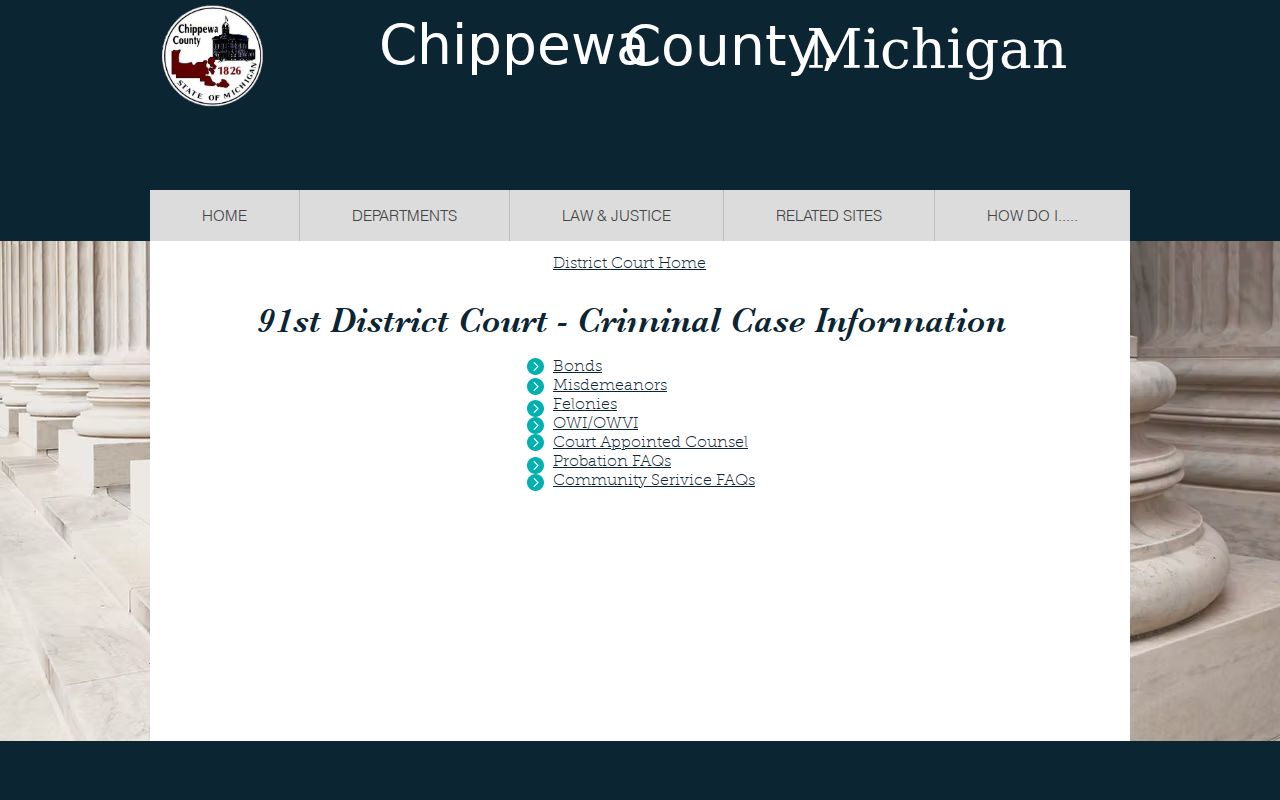
The local explanations help connect a short docket event to the stage it represents in District Court.
- Disposition
- The formal outcome of a charge or case.
- Nolle prosequi
- The prosecutor’s formal decision not to continue a charge.
- Recognizance
- Release based on a promise and conditions without cash security.
- Restitution
- Court-ordered payment for qualifying loss suffered by a victim.
Criminal Case Stages in Chippewa County
The prosecutor’s authorized charge opens the court path. At arraignment, the court states the accusation and rights, takes a plea where allowed, and addresses bond. Misdemeanors can proceed through pretrial negotiation, motions and discovery, a plea or bench or jury trial, disposition, and sentencing in District Court. A felony receives preliminary proceedings there before any transfer to Circuit Court. No fixed local timetable was published, so hearing dates in the actual docket control.
Case flow: Charges Filed › Arraignment › Pretrial › Plea or Trial › Disposition › Sentencing
The sequence explains why an early entry can differ from the final record. Charges may change before plea or trial. Some counts may be dismissed while another reaches judgment. For a full reading, compare the charging document, the dated register, and the final judgment rather than treating the first allegation as the outcome.
Chippewa County Felony Court Trails
One Chippewa County felony can leave two public trails. District Court records the arraignment, bond, probable-cause conference, preliminary examination or waiver, and bindover. Circuit Court creates a separate file for the bound-over felony, then records later pleas, motions, trial activity, disposition, and sentence. Searching only Circuit Court may hide the opening phase. Searching only District Court may stop at the transfer and omit the final result.
The official 50th Circuit Court page provides its address, dockets, and public case-search route.
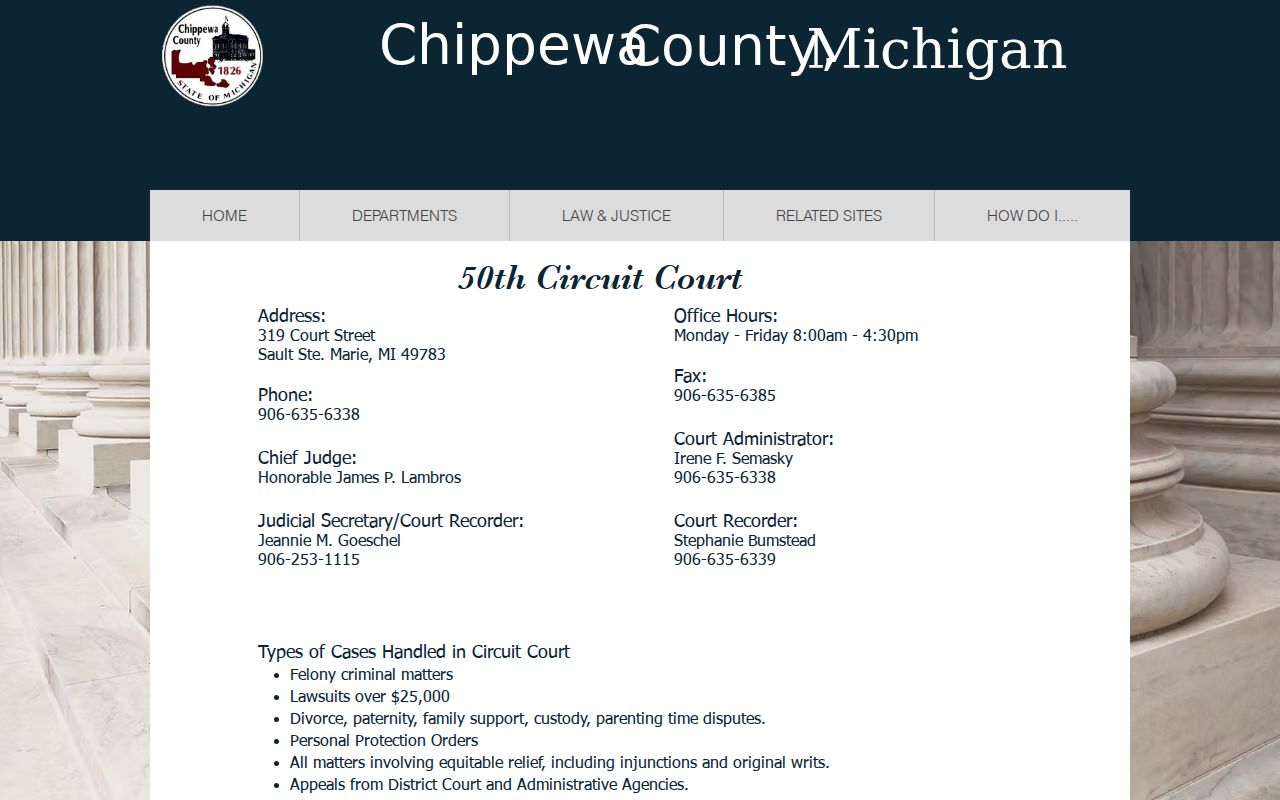
The Circuit Court source completes the local search path once a felony has moved beyond District Court.
A third-offense OWI illustrates the split. It is felony-level, but the case still begins in District Court and moves only after bindover. Match both case numbers, then ask the appropriate clerk for the document created at that stage. For the distinction between the first booking accusation and later court charges, the county’s arrest search resources cover the agency and jail side of the record.
Access Rules for Case Records
Michigan Court Rule 8.119 governs court records and public access. It is distinct from the Michigan Freedom of Information Act, which applies to nonexempt records held by executive agencies. Send a court-file request to the District or Circuit clerk. Use county FOIA for a Sheriff report or booking record. A police narrative and a criminal docket are separate records even when they arise from the same event.
Public access has limits. Juvenile delinquency matters, sealed files, set-aside convictions, victim-identifying details, personal identifiers, medical information, and protected law-enforcement material may be withheld or redacted. An online view can contain less than the clerk’s public paper file. Still, a paper file does not make confidential content public. Ask the clerk whether the case exists and whether a public document can be inspected or copied when the remote search shows nothing.
Chippewa County Court Clerk Access
Remote search, a public terminal, and a clerk request are complementary channels. Begin with MiCOURT because it can supply the exact case number. If the result is absent or too brief, use the free District Court computer or the courthouse docket displays. Then contact the clerk that holds the needed stage. A focused request should name the court, case number, party, date range, and exact document, such as the judgment of sentence or dismissal order.
Do not ask the Sheriff for a court judgment or the court clerk for an officer’s complete incident narrative. The Sheriff holds agency and custody material, while the courts hold filed charges, docket entries, orders, dispositions, and sentences. The Public Defender office at 325 Court Street handles representation and applications for appointed counsel, not public copy orders.
For a staff search in District Court, give a name, date of birth if properly known, and a time period. Allow more time for pre-computerized files. Circuit Court opens earlier in the day than District Court, so check each office’s hours before a same-day visit. Fees for clerk searches, plain copies, and certified copies were not stated in the official text reviewed. Confirm the current amount before placing an order.