
Chippewa County Criminal History Checks
No official source contains every Chippewa County criminal record. The best first step is to identify whether the question concerns a current jail stay, a police report, a filed court case, a statewide public history, prison supervision, or a registry entry. The creator of the record is normally the most direct source.
- Use ICHAT for public, reportable Michigan criminal history held by the Michigan State Police.
- Select the 91st District or 50th Circuit Court in MiCOURT Case Search, then check both courts when following a felony.
- Call Chippewa County corrections at 906-635-7620 for very recent custody because no official public online jail roster was verified.
- Request an incident or arrest report from the agency that created it, using county or Sault Ste. Marie FOIA channels as appropriate.
- Use OTIS for qualifying MDOC custody or supervision, and use fingerprints for a complete review of your own Michigan record.
A no-result screen is only an answer about that system. It is not proof that no record exists elsewhere. Tribal, federal, juvenile, traffic, suppressed, and some local matters fall outside ICHAT, while a new arrest may not yet have a court file.
Chippewa County Criminal Records on Court Street
Chippewa County concentrates its main record offices within one downtown Sault Ste. Marie block. The 50th Circuit Court is at 319 Court Street. The 91st District Court, Sheriff’s Office, corrections contacts, and Public Defender are associated with 325 Court Street. The short distance does not make the files interchangeable. Each counter controls a different part of the record.
50th Circuit Court
319 Court Street, Sault Ste. Marie, MI 49783
906-635-6338
Weekdays, 8:00 a.m. to 4:30 p.m.
91st District Court
325 Court Street, Sault Ste. Marie, MI 49783
906-635-6320
Weekdays, 9:00 a.m. to 4:30 p.m.
Chippewa County Sheriff
325 Court Street, Sault Ste. Marie, MI 49783
906-635-6355
Business office: 8:30 a.m. to 4:30 p.m.
The official Chippewa County government page shows the local department structure.
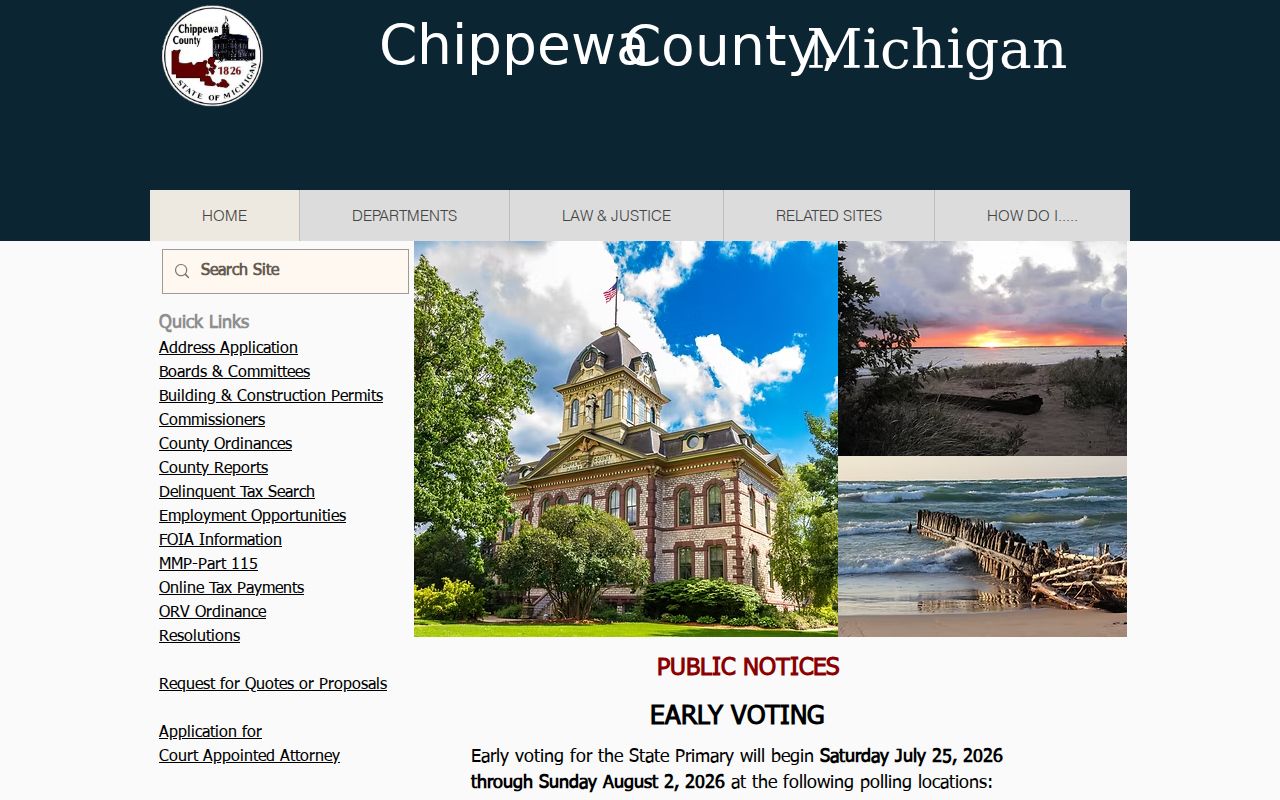
The county directory helps a reader choose the correct office before calling or traveling to the Court Street campus.
Official Background Checks in Michigan
ICHAT is Michigan’s public name-based repository check. A search requires first name, last name, gender, and exact date of birth. It costs $10. The result covers public, reportable Michigan criminal history held by the Michigan State Police Criminal Justice Information Center. It does not cover warrants, suppressed records, federal or tribal cases, traffic, juveniles, other states, or every local misdemeanor.
| Official product | Best use | Published fee |
|---|---|---|
| ICHAT | Public Michigan name check | $10 per search |
| MSP RI-008 review | Your own fingerprint-associated Michigan record | $30 MSP processing, plus capture costs |
| FBI Identity History Summary | Your own federal fingerprint history | $18 FBI fee, plus fingerprint costs |
| 91st District clerk search | Local case range selected by requester | Nominal fee; amount not published |
For a fingerprint review, use form RI-008 and an MSP-authorized Live Scan agency. The Sheriff is a local place to ask about current fingerprint service, but its schedule and capture fee were not published in the reviewed sources.
Reading Chippewa County Records Through ICHAT
An ICHAT match is strongest when the entered date of birth is exact. The system may return an MSP event cycle that links arrest data, charges, court identifiers, disposition, and sentence. A name alone can produce the wrong person, so compare identifiers and obtain the underlying Chippewa County court judgment before relying on the outcome.
| Field | Required | Why it matters |
|---|---|---|
| First name | Yes | Begins the candidate match |
| Last name | Yes | Required by the public interface |
| Gender | Yes | Narrows the MSP search |
| Date of birth | Yes | Separates people with similar names |
| Account and payment | Yes | Completes the paid report request |
The MSP criminal-history hub explains the public and nonpublic limits.
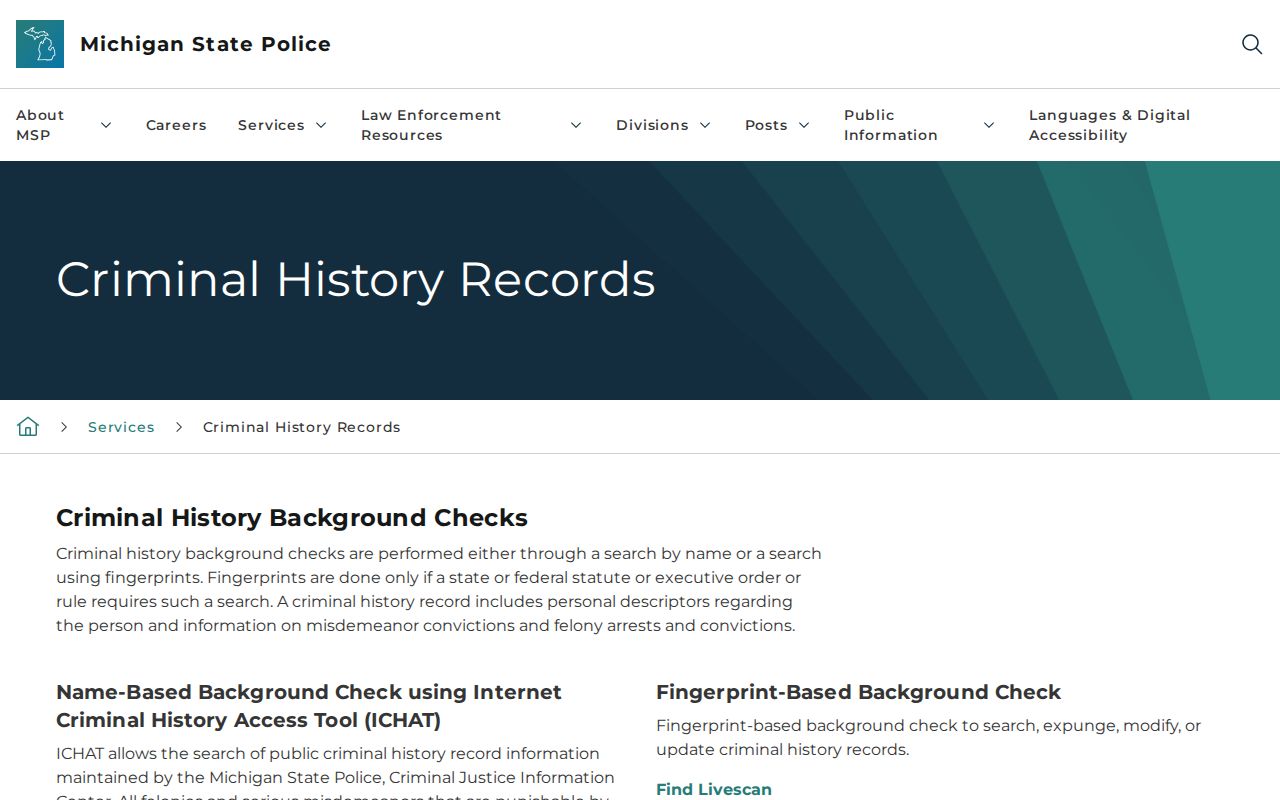
Those exclusions explain why a complete Chippewa County search often combines ICHAT with court and agency records.
Kinds of Chippewa County Criminal Records
Records follow the agencies that create them. An incident report has an officer’s narrative and alleged facts. A booking record shows intake, custody, holds, bond, and release. The District Court file holds misdemeanors and the preliminary stages of felonies. The Circuit file continues a felony after bindover. ICHAT is a state compilation, not a copy of every local source.
- Register of actions
- The dated sequence of hearings, filings, rulings, and case status recorded by a court.
- Bindover
- The transfer of a felony from 91st District Court to 50th Circuit Court after probable cause or waiver.
- Disposition
- The outcome of a charge, which may be conviction, dismissal, acquittal, or another result.
- Set aside
- A Michigan order that removes an eligible conviction from ordinary public view.
- SID
- A state identification number that connects fingerprint-supported criminal-history events.
Probation, parole, PSOR, police media, warrants, juvenile matters, and federal cases each have separate access rules. A label such as “closed” does not reveal the outcome by itself.
Chippewa County Arrest Records Without a Roster
No verified official Chippewa County web roster or public booking log was located in the research. For present custody, call corrections at 906-635-7620. For the booking record, contact the Sheriff’s business office. For the officer narrative, request the report from the arresting agency. For filed charges and the result, search the court record.
The sheriff accepts focused requests in person or by mail at 325 Court Street, or by fax at 906-635-6336. Include the approximate incident or arrest date, location, agency, record type, and report, booking, or case number if known. County FOIA fees may include lawful search, review, redaction, copying, and mailing costs. Current report-specific amounts should be confirmed with the office.
| Request detail | How it helps Chippewa County staff |
|---|---|
| Record description | Separates an offense report, booking file, 911/CAD item, and other agency material |
| Date or date range | Limits the time the Sheriff must search |
| Incident location | Helps identify the responsible agency and event |
| Report, booking, or case number | Provides the best unique key when it is known |
| Preferred format | States whether the requester seeks inspection, electronic delivery, or paper |
The county’s reviewed pages did not confirm a sheriff-specific online request portal or an email submission address. Ask the business office before sending personal identifiers by ordinary email. A focused request also reduces unnecessary review and redaction time.
For a fuller explanation of the custody trail, use the Chippewa County arrest search page.
Chippewa County Criminal Records: What They Contain
The useful fields depend on the source. An MSP history begins with identity data and organizes qualifying events into cycles. A court file centers on the case number, parties, charges, hearings, judge, counsel, disposition, sentence, and financial obligations. Booking records emphasize arrival and release. Comparing unlike documents can make a change in charges look like an error when it is part of the normal process.
| Police or sheriff report | Incident time, place, officers, narrative, reported conduct, and initial allegations |
|---|---|
| Booking record | Intake, identity, custody status, holds, booked charges, bond, and release |
| District Court file | Arraignment, bond, misdemeanor events, and felony preliminary proceedings |
| Circuit Court file | Felony information, motions, plea or trial, judgment, and sentence |
| ICHAT history | Public reportable state events connected through identifiers and qualifying reports |
Chippewa County Court Records Beyond MiCOURT
MiCOURT requires the user to choose a participating court. A felony can have one District Court matter and a later Circuit Court matter, so search both. Results may show a case number, party, type, filing date, status, and register of actions, but a docket does not promise downloadable document images.
When remote search fails, the 91st District Court provides a free public-access computer during normal business hours. Clerk-assisted searches use a name, preferably a date of birth, and a time period. The normal search range is ten years. Records more than 25 years old take extra time because they are not fully computerized. Circuit dockets also appear on courthouse kiosks in the basement and on the second floor.
The Michigan trial-court directory explains the state court structure.
That structure is why a complete felony search follows the matter from 91st District Court into the 50th Judicial Circuit.
Michigan Public Access Laws
Michigan FOIA applies to executive-branch agency records such as sheriff and city police reports. Court records use Michigan Court Rule 8.119 and clerk procedures instead. Public access can still involve redaction or withholding for active investigations, juvenile information, victims, medical material, LEIN data, personal identifiers, sealed matters, and other protected content.
Key Michigan authorities:
Michigan FOIA, MCL 15.231 to 15.246 sets request, fee, response, exemption, and appeal rules for public-body records.
MCL 28.242a authorizes dissemination of specified public criminal-history information through ICHAT.
Michigan Court Rule 8.119 governs public access to court records and confidential or sealed material.
MCL 780.621g sets criteria and timing for Michigan automatic set-asides.
A FOIA response is generally due within five business days, with a permitted ten-business-day extension. That deadline concerns the response, not a promise that all records will be produced then.
Chippewa County Warrant Record Checks
ICHAT excludes warrants, and no complete official public county warrant list was verified. Ask the issuing court and the Chippewa County Sheriff’s Warrant Officer. MiCOURT may show a bench-warrant event, but a docket clue is not the same as direct confirmation. An unserved or sealed warrant may not be public.
Provide a full legal name, date of birth when appropriate, and any case number. Resolve your own possible warrant directly with the court or counsel rather than relying on a general web result. District Court handles bench warrants tied to its cases, while a felony file may continue in Circuit Court after bindover.
Restricted, Sealed & Expunged Records
Michigan uses “set aside” for much conviction relief and also refers to expungement and Clean Slate. Juvenile delinquency, sealed cases, victim data, personal identifiers, and valid set-aside convictions do not appear like ordinary public files. Eligibility depends on the offense and complete history, with serious statutory exclusions.
An application usually calls for certified court records, fingerprints, an MSP record, the current state form, filing in the court of conviction, required service, and any scheduled hearing. A Chippewa misdemeanor starts with 91st District Court; a Circuit felony application goes to the 50th Circuit. Automatic processing is not instantaneous. Keep the signed order and verify both the court view and ICHAT after processing.
Chippewa County Corrections Records in OTIS
The Michigan Department of Corrections Offender Tracking Information System can show people in MDOC custody or on qualifying felony probation or parole. It is not a full criminal-history check. MDOC states that OTIS generally retains discharged supervision records for three years, so disappearance from the locator does not erase an underlying conviction.
The official OTIS search is the state corrections channel.
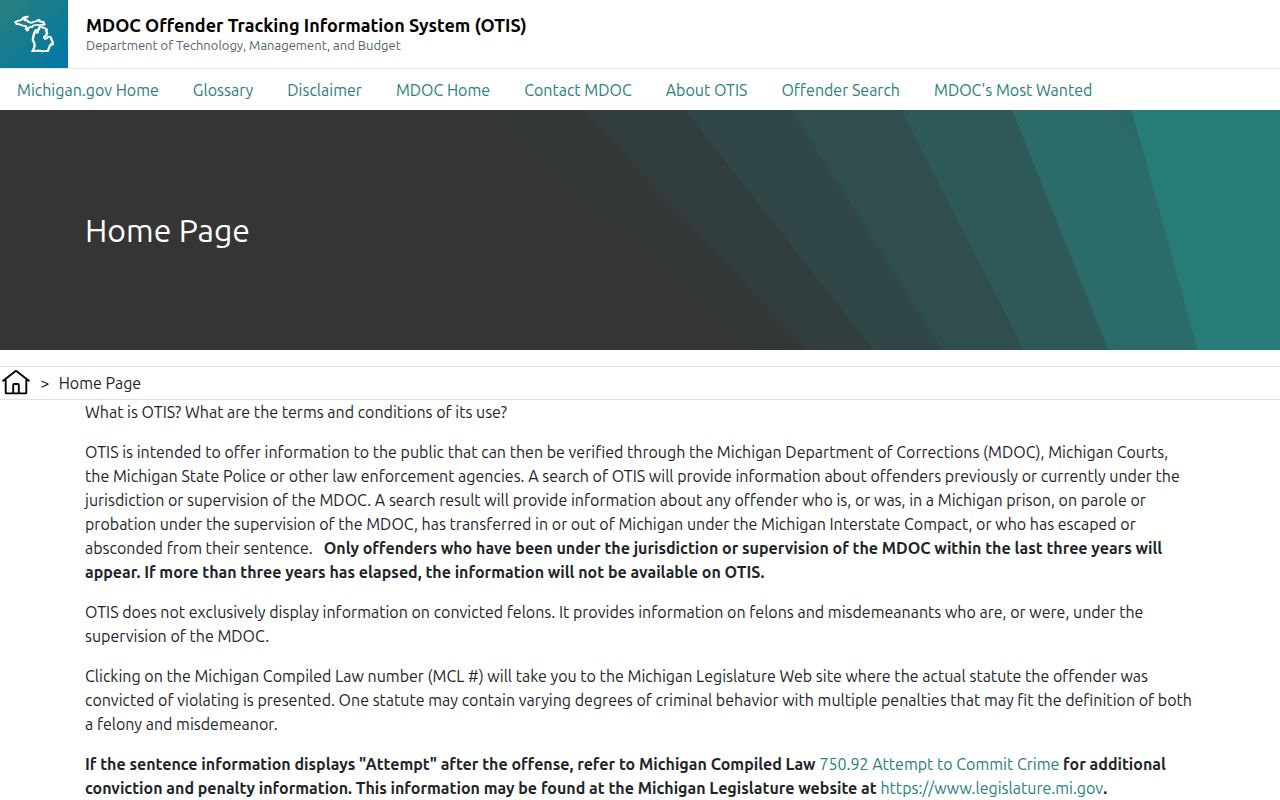
Use the court judgment to confirm the conviction and sentence, and treat OTIS as a current or recent supervision summary.
Chippewa County Criminal Records Outside Michigan Portals
Chippewa County’s border setting and tribal jurisdictions make source labels especially important. ICHAT and MiCOURT do not provide a federal or tribal case file. Federal matters for Chippewa County fall within the U.S. District Court for the Western District of Michigan. PACER is the official federal docket system, and the Bureau of Prisons locator addresses federal custody.
Tribal police and courts follow their own record rules. A state “no result” cannot be stretched into a statement about a tribal matter. First identify the arresting agency and court. The FBI Crime Data Explorer and Michigan Incident Crime Reporting program should also be filtered by agency and year so Sault Police, Sheriff, MSP, tribal, and campus figures are not mislabeled as one county total.
Correcting a Chippewa County Criminal Record
When a public history shows the wrong outcome, obtain the ICHAT result, identify the arrest cycle or disposition in question, and collect the Chippewa County judgment or dismissal. MSP provides a process to search, expunge, modify, or update criminal-history records. Courts may use the RI-027 Judicial Correction Worksheet when a disposition cannot be sent electronically.
The MSP FOIA and records page distinguishes state record-request channels.
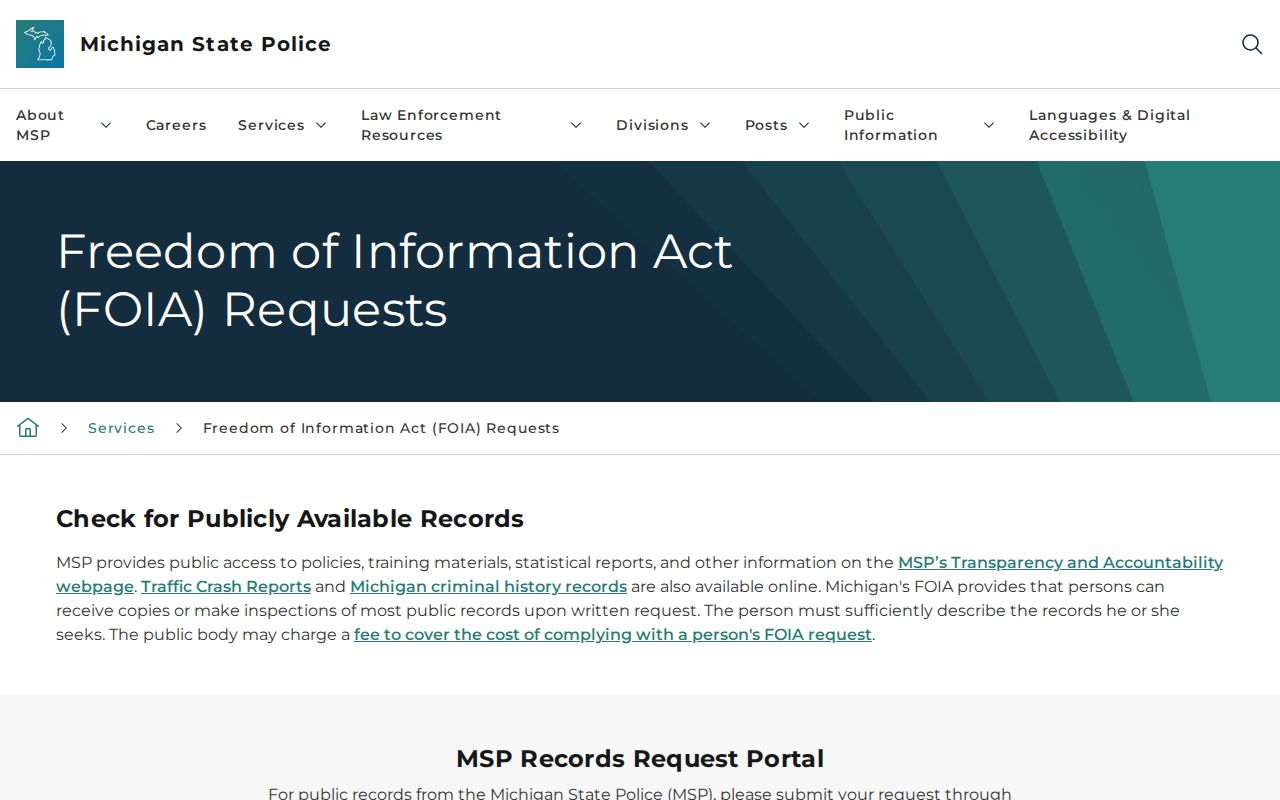
The court supplies the source result; MSP cannot create a missing judicial outcome without supporting court documentation.
Chippewa County Probation and Parole Records
Community supervision has two local paths. The 91st District Court operates misdemeanor probation, while the Michigan Department of Corrections supervises state felony probation and parole. A District Court judgment or docket is the better public source for the sentence itself. OTIS can identify qualifying MDOC supervision, but officer notes and day-to-day case-management information are not necessarily public.
When checking Chippewa County supervision, begin with the court that imposed sentence. Use the District probation office only for information it may lawfully release. For felony probation or parole, use OTIS to identify the status and field-office context, then return to the Circuit Court judgment for the formal terms. The Michigan Parole Board within MDOC makes parole decisions, and a parole status does not alter the underlying conviction record.
City-by-City Criminal Records in Chippewa County
Sault Ste. Marie is Chippewa County’s only incorporated city and the county seat. City police create their own reports, while bookings use the county correctional system and criminal cases proceed in the county courts. There is no separate Sault Ste. Marie municipal criminal court database.
Sault Ste. Marie Record Check
Use Sault Police and City Clerk FOIA for police records, then 91st District and 50th Circuit for court outcomes.